
Peach Sapphire vs Morganite Durability: Which Gemstone Lasts a Lifetime?

Selecting a gemstone based on its initial visual appeal can often mask a significant technical risk to the jewelry's long-term performance. While both stones offer a stunning warm palette, the reality of peach sapphire vs morganite durability reveals two distinct trajectories for an engagement ring intended for a lifetime of wear. You deserve a piece that maintains its structural integrity, yet the common fear of surface scratching or a permanent loss of sparkle is a valid technical concern.
We recognize that an investment of this nature requires a balance of aesthetic precision and material reliability. This guide provides a clear breakdown of the physical properties, including hardness and refractive indices, that determine how each stone withstands daily environmental stressors. You'll gain a comprehensive understanding of the maintenance protocols and the long-term viability of each option. This objective data will validate your purchase decision and ensure your ring remains as brilliant in twenty years as it is on the day of delivery.
Key Takeaways
- Assess the technical performance of corundum versus beryl to determine which mineral structure best supports the rigors of daily wear.
- Examine the refractive index data to understand why peach sapphire maintains its optical clarity while morganite often requires more frequent maintenance to avoid a cloudy appearance.
- Calculate the long-term viability of your purchase by comparing peach sapphire vs morganite durability and the potential costs associated with stone replacement cycles.
- Distinguish between the soft pastel glow of morganite and the high-brilliance performance of sapphire to align with your specific aesthetic and technical requirements.
- Receive expert guidance on when to prioritise structural hardness for an engagement ring versus selecting a more cost-effective stone for occasional-wear jewelry.
The Peach Aesthetic: Understanding Sapphire and Morganite Basics
The rise of warm, sunset-toned jewelry has shifted the focus of modern design away from traditional white diamonds toward more nuanced palettes. For many couples, the choice between gemstones in this category often centers on the technical debate of peach sapphire vs morganite durability. While both stones offer a sophisticated blush or champagne hue, they belong to entirely different mineral families with distinct physical properties. Understanding these baseline characteristics is the first step in determining which stone aligns with your lifestyle and performance expectations.
Sapphire is a variety of the mineral corundum, a crystalline form of aluminium oxide. It is globally recognized for its extreme hardness, ranking at 9 on the Mohs scale, which makes it the hardest natural gemstone after diamond. Conversely, morganite is a variety of beryl, placing it in the same mineral family as emerald and aquamarine. These stones have become the leading alternatives to diamonds because they offer a "soft luxury" aesthetic that feels both contemporary and timeless. However, their internal chemistry dictates how they will age over decades of daily wear.
Peach Sapphire: The Rare Corundum
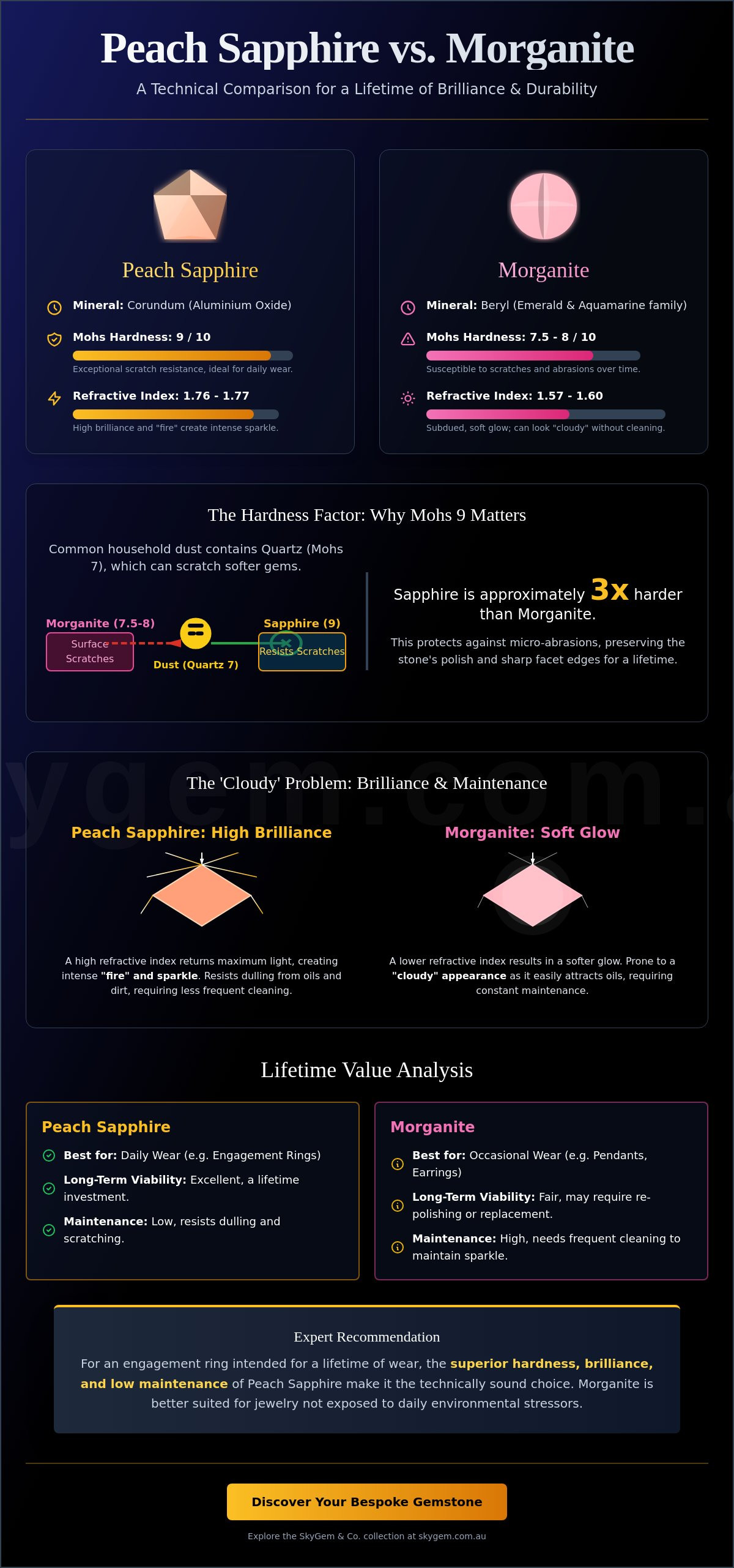
The specific peach hue in sapphire is the result of trace elements like iron and chromium within the corundum crystal lattice. Finding these stones in their natural, unheated state is exceptionally rare. In the current market, approximately 95% of sapphires undergo standard heat treatment to stabilize and refine their color. Because of its high refractive index, which ranges from 1.76 to 1.77, a high-quality peach sapphire exhibits significant brilliance and fire. It doesn't just hold its color; it reflects light with a technical precision that resists the "dulling" effect often seen in softer stones.
Morganite: The Romantic Beryl
Morganite owes its delicate pinkish-orange tones to the presence of manganese. It is prized for its "watery" or pastel appearance, which provides a softer visual impact than the saturated sparkle of a sapphire. This beryl variety is frequently set in rose gold to create a monochromatic, romantic look that has dominated social media trends for several years. While its initial appearance is captivating, morganite's lower refractive index of 1.57 to 1.60 results in a more subdued glow. It lacks the internal "fire" of corundum, which is a critical factor when considering peach sapphire vs morganite durability and long-term optical performance.
Choosing between these two requires a balance of aesthetic preference and a realistic assessment of wear and tear. While morganite offers an accessible entry point into the peach aesthetic, the structural density of sapphire provides a level of security that beryl simply cannot match in a high-contact environment like an engagement ring.
The Hardness Factor: Mohs Scale and Structural Integrity
Technical specifications for jewelry performance often begin with the Mohs scale, a relative measure of mineral scratch resistance. When analyzing peach sapphire vs morganite durability, it's vital to recognize that this scale is non-linear. The jump from one integer to the next doesn't represent a uniform increase in resistance. Instead, the gaps between higher numbers are significantly larger. Sapphire, at a 9, is not just slightly harder than morganite, which sits between 7.5 and 8; it represents a substantial leap in material density and surface protection.
Environmental factors play a silent role in the degradation of softer stones. Common household dust frequently contains microscopic particles of quartz, which has a hardness of 7. Because morganite’s hardness is relatively close to that of quartz, simple actions like wiping the stone with a dry cloth can eventually lead to micro-abrasions. Over several years, these tiny scratches accumulate, dulling the surface and reducing the stone's ability to transmit light. Sapphire remains unaffected by these daily contaminants, maintaining its factory polish because its molecular structure is significantly harder than the silica-based particles found in the air.
Why a 9 on the Mohs Scale Matters for Engagement Rings
In practical terms, a sapphire is approximately three times harder than a morganite. This delta is critical for engagement rings that are subjected to high-contact environments. High scratch resistance preserves the sharp facet edges that define a well-cut stone. When facet edges wear down on a softer stone like morganite, the gemstone loses its "crisp" appearance and begins to look rounded or fuzzy. A sapphire setting provides a structural guarantee that the stone's geometry remains unchanged over decades of wear.
Cleavage and Chipping: Structural Risks
Beyond surface hardness, we must consider a mineral's "toughness," or its resistance to fracturing. Beryl, the mineral family for morganite, is inherently more brittle than corundum. While morganite has indistinct cleavage, it's more prone to internal fractures and chipping when it sustains a direct impact against a hard surface. Sapphire lacks a cleavage plane entirely, meaning it doesn't have a natural "weak spot" where it's likely to split. This lack of cleavage, combined with its high density, makes sapphire one of the most durable options for a permanent jewelry asset. If you're seeking a stone that can withstand the accidental knocks of a busy lifestyle, the structural integrity of corundum offers a level of reliability that beryl cannot match.
The 'Cloudy' Problem: Refractive Index and Maintenance
A frequent observation among owners of blush-toned jewelry is that their stone appears "dead" or "lifeless" shortly after purchase. This aesthetic decline is rarely a result of permanent damage. Instead, it's a consequence of optical physics and chemical affinity. When evaluating peach sapphire vs morganite durability, you must consider not just how the stone resists scratches, but how it maintains its brilliance between cleanings. The "cloudy" look that plagues many beryl stones is a direct result of their lower refractive index and their tendency to attract environmental contaminants.
The Science of Scintillation
The Refractive Index (RI) measures the degree to which light bends and slows as it enters a gemstone. Sapphire has a high RI of 1.76 to 1.77, which allows it to reflect a significant percentage of light back to the eye. This high-performance light return creates the "fire" and "scintillation" expected from a premium gemstone. Conversely, Morganite has a lower RI of 1.57 to 1.60. This technical difference means that light is more easily lost through the bottom of the stone rather than being reflected back to the viewer.
This optical gap becomes more pronounced when the stone is soiled. Because sapphire reflects light so efficiently, it maintains a level of sparkle even when a thin layer of dust or oil is present. Morganite's lower RI makes it far less forgiving. Even a minor amount of dirt on the underside of the stone will disrupt the light path, causing the gemstone to look flat or "cloudy" almost instantly. This is why a natural sapphire often looks brilliant even after a week of wear, while a morganite may lose its visual impact within forty-eight hours.
Daily Wear Realities
Morganite requires weekly professional-grade cleaning to stay bright. This necessity stems from the stone's lipophilic nature, which causes it to act as a magnet for oils found in hand lotions, soaps, and skin. These oils create a stubborn film on the pavilion facets, effectively "turning off" the stone's ability to reflect light. Sapphire is significantly more resistant to this oil buildup, allowing for a more relaxed maintenance schedule. While a sapphire might only need a deep clean every few weeks, a morganite owner must be diligent to prevent the stone from looking permanently dull. This ongoing maintenance requirement is a critical factor in the long-term satisfaction of your purchase.
Lifetime Value Analysis: Investment vs. Initial Cost
Viewing an engagement ring through the lens of a one-off purchase often leads to technical oversights in long-term financial planning. The initial procurement cost is merely the baseline; the true value is determined by the "cost per year" over several decades. When evaluating peach sapphire vs morganite durability from a financial perspective, the higher entry price of sapphire reflects its status as a permanent asset. Morganite, while attractive for its immediate affordability, often carries hidden liabilities that emerge as the stone reaches its performance limits in a daily-wear environment.
A professional assessment must account for the rarity of the material. Natural peach sapphires, particularly those that are unheated, are finite resources with a tightening global supply. This scarcity drives long-term value retention and makes them suitable as heirloom pieces. Morganite is a high-supply commercial stone. Its market value remains relatively flat because it lacks the geological rarity associated with the "big three" precious gemstones. Choosing a sapphire isn't just an aesthetic preference; it's a strategic decision to invest in a mineral that holds its position in the global market.
The Replacement Risk
The "Stone Replacement Cycle" is a documented reality for softer gems. A chipped or heavily abraded morganite cannot always be repaired; it often requires a total replacement. This process introduces an emotional toll, as the original stone from the proposal is lost. Beyond the cost of the new gem, you must consider the technical risk to the jewelry itself. Every time a jeweler opens and closes gold prongs to reset a stone, the metal undergoes work-hardening and fatigue. Repeated replacements can eventually compromise the structural integrity of the entire setting, leading to more expensive repairs or a full ring remake.
Market Rarity and Appreciation
The distinction between precious and semi-precious stones is largely defined by their scarcity and historical performance. You can examine SkyGem's selection of natural sapphires to see how high-quality corundum serves as a benchmark for investment-grade jewelry. Unlike morganite, which is abundant in large sizes, fine-quality peach sapphires in the 1 to 3-carat range are increasingly difficult to source. This supply-demand imbalance suggests that sapphire will continue to appreciate, whereas morganite remains a consumable fashion item. For a permanent symbol of commitment, the technical and financial stability of sapphire provides a superior return on investment.
If you're ready to secure a stone that balances technical performance with lasting value, consider a custom-made engagement ring melbourne designed for a lifetime of wear.
Expert Recommendation: Choosing Your Bespoke Gemstone
The final decision between peach sapphire vs morganite durability rests on a technical evaluation of how the jewelry will be utilized. For an engagement ring intended for daily wear over several decades, the peach sapphire is the superior engineering choice. Its position as the second-hardest natural mineral ensures that the stone's facet edges remain sharp and its surface free from micro-abrasions. For clients who prioritize high-frequency scintillation and a "set-and-forget" maintenance profile, the sapphire provides a level of reliability that matches the significance of the occasion.
Morganite remains a practical selection for specific use cases where the technical constraints are less rigid. It excels in large-scale cocktail rings or occasional-wear jewelry where a "watery" pastel aesthetic is desired at a lower initial price point. If you select morganite for an engagement ring, it should be with the professional understanding that the stone requires disciplined cleaning and may eventually require a replacement to maintain its original luster. Balancing these expectations early in the design process prevents future dissatisfaction with the stone's performance.
Designing for Durability
Technical protection can be integrated into the jewelry's architecture to mitigate the risks associated with softer stones. A bespoke engagement ring design allows for the inclusion of protective elements like bezel settings, which surround the gemstone's girdle with a secure metal rim. Alternatively, a halo setting serves as a structural "bumper," absorbing lateral impacts that might otherwise cause chipping. We recommend using 18k gold or platinum for these settings; these metals provide the necessary density and tensile strength to hold the gemstone securely over time, regardless of the mineral variety chosen.
The SkyGem Standard
Our approach to gemstone selection focuses on long-term viability and ethical transparency. We prioritize sourcing unheated stones that exhibit natural color stability, ensuring your investment doesn't rely on temporary treatments. To elevate the visual impact of a peach center stone, we often suggest incorporating GIA certified diamonds as side stones. The high-contrast brilliance of a diamond halo or trilogy setting can significantly enhance the perceived saturation of a peach sapphire or morganite.
Selecting a gemstone is a technical partnership. Seeing these stones in various lighting environments is the only way to truly appreciate the difference in refractive performance and color depth. Book a consultation at SkyGem & Co. to find your perfect peach gemstone and ensure your design is built to last a lifetime.
Securing Your Legacy with Technical Precision
The technical data consistently favors corundum for high-performance jewelry applications. By prioritizing a mineral with a 9 on the Mohs scale and a superior refractive index, you eliminate the risks of surface abrasion and optical "cloudiness" that often affect softer beryl varieties. This objective analysis of peach sapphire vs morganite durability confirms that while both stones offer beautiful aesthetics, only one provides the structural density required for a permanent asset. Choosing a sapphire ensures that your ring's geometry and brilliance remain unchanged by the rigors of daily wear.
At SkyGem & Co., we combine expert gemmological advice with hand-finished bespoke settings to ensure your choice is both ethically sourced and technically sound. Investing in a stone that maintains its brilliance without an expensive replacement cycle is a decision that respects both your aesthetic vision and your long-term resources. Explore our curated collection of natural Peach Sapphires to find a stone that looks as exceptional in twenty years as it does today. We look forward to partnering with you on this significant project.
Frequently Asked Questions
Can I wear a morganite ring every day?
You can wear a morganite ring daily, but it requires much more caution than a sapphire. Because it ranks 7.5 to 8 on the Mohs scale, it's susceptible to micro-abrasions from common household dust. To maintain its integrity, you should remove the ring during manual activities or any task that involves contact with abrasive surfaces.
Does peach sapphire scratch easily?
Peach sapphire is exceptionally resistant to scratching and surface wear. As a variety of corundum with a Mohs hardness of 9, it's harder than almost any material you'll encounter in daily life. This physical density is a key advantage in the peach sapphire vs morganite durability comparison, as it ensures the facet edges stay sharp for decades.
Why does my morganite ring look dull and cloudy?
Your morganite likely looks cloudy because it's lipophilic, meaning it naturally attracts oils from soaps, lotions, and skin. These oils create a film on the pavilion facets that disrupts light return. Because morganite has a lower refractive index than sapphire, even a small amount of buildup makes the stone appear "dead" or flat.
Is peach sapphire more expensive than diamond?
Generally, peach sapphire is more affordable than a natural diamond of similar size and clarity. It offers a way to secure a significant center stone without the high per-carat cost of a diamond. Rare Padparadscha varieties are the exception, as their unique pink-orange balance can command premium prices that rival high-grade diamonds.
How do I clean a peach sapphire engagement ring at home?
Clean your sapphire ring using warm water and a mild, oil-free dish soap. Soak the ring for ten minutes, then use a soft-bristled toothbrush to gently remove debris from behind the setting. This routine effectively restores the stone's high-refractive sparkle without the need for professional equipment or harsh chemical solutions.
What is the best setting for a morganite ring to prevent chipping?
A bezel setting is the most secure choice for protecting a morganite stone from accidental knocks. By encasing the stone's girdle in a rim of metal, you shield its most vulnerable points from fractures. A halo setting is another effective alternative, providing a perimeter of smaller diamonds that act as a structural bumper.
Are all peach sapphires heat-treated?
Approximately 95% of sapphires on the market are heat-treated to optimize their color and clarity. This is a permanent, stable, and industry-standard process that doesn't affect the stone's longevity. Unheated peach sapphires exist but are significantly rarer and carry a higher price point due to their natural, untouched state.
Can a jeweller tell the difference between morganite and peach sapphire just by looking?
A professional can often distinguish the two by examining the sharpness of the facet junctions and the intensity of the light return. Sapphire looks "crisper" and exhibits more internal fire due to its higher refractive index. For a technical confirmation, a gemmologist will use a refractometer to verify the stone's specific optical properties.
Disclaimer
This article is for general informational purposes only and may include AI-assisted content. Pricing, specifications, and availability are subject to change. For accurate advice and current information, please contact SkyGem & Co. directly. Nothing in this content constitutes professional or financial advice.