
Peach Sapphire Engagement Rings: The Definitive Australian Guide for 2026

A peach sapphire is the technical sweet spot of the gemstone world, offering the structural resilience of corundum paired with a sophisticated, neutral palette. While many are initially drawn to the soft tones of morganite, that stone's lower hardness often leads to a loss of brilliance over time. Choosing a peach sapphire engagement ring australia ensures you don't have to compromise between aesthetic warmth and long term durability. We recognize that an engagement ring is a significant investment that must withstand the rigours of daily life while maintaining its optical performance. This guide provides the technical clarity you need to navigate the selection process with confidence. You'll learn how to grade these rare stones for maximum light return and how to pair them with specific metals for the best colour payoff. We also detail how the Australian Consumer Law protects your purchase and what the latest 2026 regulatory updates mean for your bespoke design journey.
Key Takeaways
- Identify the technical specifications needed for a high-performance stone, focusing on colour saturation and "eye-clean" clarity rather than standard diamond metrics.
- Learn why a peach sapphire engagement ring australia is the superior choice for daily wear by comparing the Mohs scale rating of corundum against softer stones.
- Optimise your ring's visual profile by choosing 18ct gold or platinum alloys that complement the sapphire's unique sunset hues.
- Explore the transition from digital CAD rendering to hand-finished craftsmanship to ensure your bespoke design achieves both precision and durability.
- Gain clarity on ethical sourcing and unheated certifications to protect your investment's long-term value and provenance.
The Rising Sophistication of Peach Sapphire Engagement Rings
Peach sapphires have transitioned from a niche collector's gem to a cornerstone of modern Australian bridal design. As a variety of the mineral corundum, these stones offer the same structural integrity as their blue counterparts while providing a unique "sunset" palette. This range spans from delicate champagne and soft apricot to deeper, more saturated peach hues that evoke the warmth of the Australian landscape. For many seeking a peach sapphire engagement ring australia, the appeal lies in the stone's ability to offer a sophisticated alternative to traditional diamonds without sacrificing the durability required for a lifetime of wear. The shift toward these warm, neutral tones reflects a broader movement toward bespoke aesthetics that prioritise personality over mass-market trends.
What Defines a True Peach Sapphire?
The distinctive hue of a peach sapphire is the result of specific trace elements within the crystal lattice, primarily iron and chromium. While these elements are also responsible for the vibrant reds in rubies and pinks in other sapphires, their specific concentration in peach varieties creates a balanced, warm tone. Understanding Sapphire mineral properties is essential for identifying quality; unlike the rare and strictly defined Padparadscha sapphire, which requires a precise mix of pink and orange, peach sapphires offer a broader, more versatile spectrum. A true peach sapphire serves as a high-clarity alternative to traditional bridal stones, often appearing eye-clean even in lighter, more transparent cuts. This clarity is vital because the lighter saturation of peach stones can easily reveal internal inclusions that would be hidden in darker blue or green varieties.
The Aesthetic Advantage: Versatility and Undertones
One of the most significant advantages of this gemstone is its neutral warmth. Peach tones naturally complement a wide array of skin tones, providing a subtle glow that feels integrated rather than stark. While diamonds are prized for their "fire" or light dispersion, sapphires are celebrated for their "glow," a depth of colour that remains consistent under various lighting conditions. In the context of bespoke Australian jewellery, there is a distinct preference for natural sapphires that have not undergone heat treatment. These unheated stones are increasingly rare in the global market, making them a prestigious choice for couples who value geological authenticity. Because most sapphires on the market are heat-treated to enhance colour, finding a natural stone with a perfect peach balance requires technical expertise and a dedicated sourcing network. The result is a peach sapphire engagement ring australia that feels both timeless and deeply personal, reflecting a shift toward individual expression in the 2026 bridal landscape.
Evaluating Quality: The Technical Standards of a Fine Peach Sapphire
Evaluating the quality of a peach sapphire engagement ring australia requires a departure from the rigid 4C framework used for white diamonds. While carat weight remains a factor, the value of a sapphire is primarily driven by the complexity and rarity of its colour. Technical grading for coloured gems focuses on the interaction between light and the stone's internal chemistry. For instance, unheated specimens command a significant premium because they represent the stone in its natural state. Heat treatment is a standard industry practice used to dissolve silk inclusions and improve colour saturation, but unheated stones remain the preferred choice for those seeking geological authenticity and long term value retention.
Colour Saturation and Secondary Hues
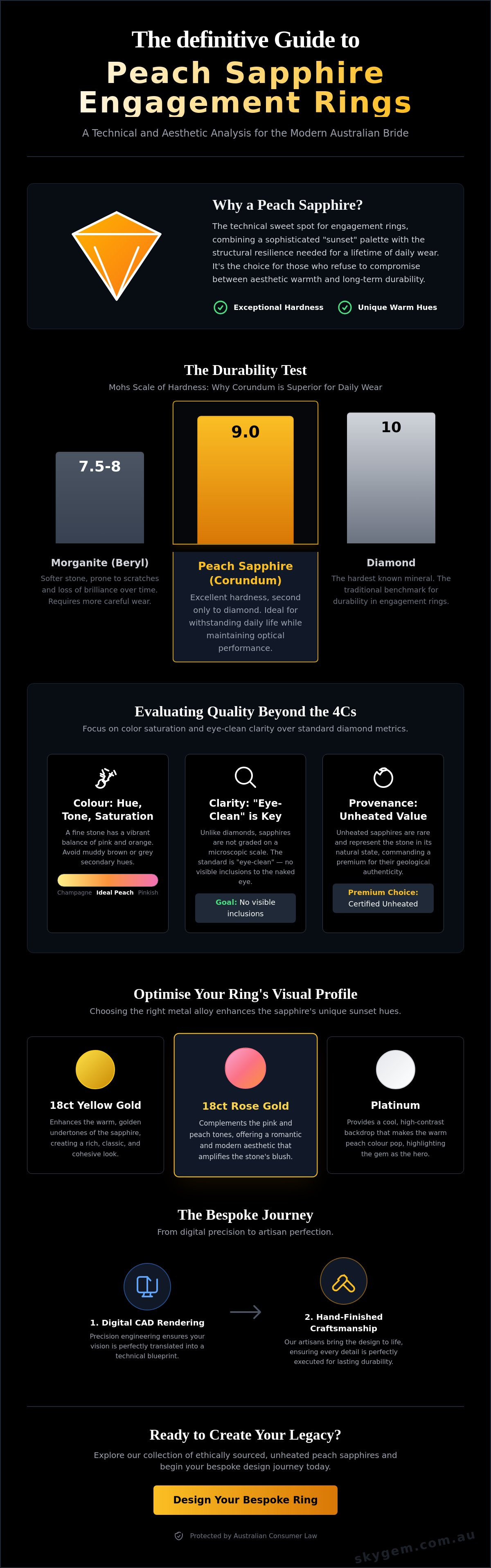
The visual profile of a peach sapphire is defined by three primary components: hue, tone, and saturation. Hue refers to the basic colour, tone describes the lightness or darkness, and saturation is the intensity of that colour. A high quality stone avoids secondary brown or grey hues, which can "muddy" the appearance and reduce light return. There is a critical technical distinction in light performance between "Champagne" and "Peach" stones that many buyers overlook. Champagne varieties often feature a yellow dominant secondary hue that can appear flat under certain lighting. In contrast, a true peach sapphire maintains a vibrant balance of pink and orange that responds dynamically to its environment. We recommend evaluating these stones in both natural Australian sunlight and controlled indoor environments to observe how the colour shifts across different spectral conditions.
Clarity and Brilliance in Light-Coloured Gems
In lighter toned sapphires, inclusions are far more visible than they are in dark blue or teal varieties. Achieving an "eye-clean" standard is essential for a peach sapphire engagement ring australia to ensure the stone's brilliance isn't compromised by internal flaws. The cut of the stone plays a critical role in this performance. If a stone is cut too shallow, it creates a "window," which is a transparent area where light passes through the back of the gem rather than reflecting to the eye. Conversely, a stone cut too deep may appear overly dark, losing its signature warmth. According to GIA's sapphire quality factors, the goal is a precision cut that maximises brilliance while maintaining the stone's saturated hue.
- Brilliant Cuts: These feature triangular and kite shaped facets designed to maximise light return and create the "fire" often associated with bridal jewellery.
- Step Cuts: These use long, parallel facets that highlight the stone's clarity and colour depth, though they are less forgiving of inclusions.
Finding the right balance between carat size and visual purity is a technical challenge that defines the success of a bespoke project. If you're beginning your search for a centre stone, exploring our collection of precious gemstones can provide a practical baseline for comparing saturation levels and cut styles.
Selecting the Perfect Setting: Metal Pairings and Design Aesthetics
Selecting a peach sapphire engagement ring australia involves more than just stone selection; the architecture of the setting dictates both the ring's visual profile and its structural longevity. While aesthetic preference often leads the design process, the technical compatibility between the metal alloy and the gemstone's optical profile is equally critical. A well-engineered setting protects the stone's edges while allowing sufficient light entry to maintain brilliance. This is where custom engagement ring design becomes essential. By tailoring the mount to the specific dimensions of a sapphire, we ensure the stone is secure without compromising its delicate colour saturation. For a ring intended for daily wear, 18ct gold and platinum are the industry standards due to their superior tensile strength and resistance to deformation.
The choice of setting style also impacts the stone's performance. Minimalist solitaires allow for maximum light exposure from all angles, which is ideal for lighter peach tones. Conversely, intricate halo settings use a perimeter of smaller diamonds to create a high-contrast border that can make the central sapphire appear more vibrant. When designing these pieces, we focus on the precision of the claws and the height of the gallery to ensure the ring remains practical for the Australian lifestyle while showcasing the stone's unique properties.
The Warmth of Rose and Yellow Gold
18ct rose gold is the most frequent pairing for peach sapphires because the copper content in the alloy mirrors the pink undertones of the stone. This creates a monochromatic, seamless look that enhances the gem's natural warmth. Yellow gold serves a different technical purpose, often used to "pull" the more golden or apricot hues out of a champagne-leaning sapphire. When evaluating these pairings, it's helpful to reference GIA's guide to sapphire quality factors to understand how light interacts with different colour environments. For long-term durability, we recommend 18ct alloys over 14ct or 9ct alternatives, as they offer better corrosion resistance and a richer colour payoff that won't fade with time.
Modern Contrast: Platinum and White Gold
While rose gold is a traditional choice, white metals offer a modern, high-contrast aesthetic that shouldn't be overlooked. Platinum and white gold provide a neutral, bright background that allows the peach hue to "pop" rather than blend in. This "crisp" look is often enhanced by the addition of white diamond side stones, which provide a colourless frame that emphasises the sapphire's saturation. You can view examples of this architectural contrast in our white gold engagement ring collection. Platinum is particularly valued for its density and "memory," meaning it holds gemstones more securely over decades of wear, making it a premier choice for heirloom-quality peach sapphire engagement ring australia projects.
Peach Sapphire vs. Alternatives: Durability and Long-Term Value
A common misconception in the bridal industry is that peach sapphires and morganites are functionally interchangeable due to their similar visual profiles. From a technical perspective, this comparison is inaccurate. While both stones offer beautiful sunset hues, their performance metrics under the stress of daily wear are vastly different. Choosing a peach sapphire engagement ring australia is an investment in a material that maintains its structural and optical integrity over decades; softer alternatives often require replacement or intensive maintenance within years. We view the selection of a centre stone as a technical decision that impacts the long-term success of the ring's design.
Hardness and the Rigors of Daily Wear
Gemstone durability is measured by the Mohs scale of mineral hardness, which ranks a stone's resistance to scratching. Sapphires possess a rating of 9, making them significantly more resilient than morganite, which sits at approximately 7.5. This difference isn't linear; a sapphire is roughly four times harder than a morganite. Beyond surface hardness, sapphires exhibit exceptional "toughness," which refers to the mineral's resistance to chipping or fracturing under impact. Only diamonds surpass sapphires in scratch resistance, ensuring that the facets of your ring remain sharp and clear despite the friction of daily activity. This structural stability is why corundum is the preferred choice for a piece of jewellery intended to be worn for a lifetime.
Refractive Index and Scintillation
The visual longevity of a stone is also tied to its chemical affinity for environmental contaminants. Morganite is "lipophilic," meaning it naturally attracts oils from skin, lotions, and soaps. This characteristic leads to a persistent cloudy appearance that obscures the stone's brilliance and requires frequent professional cleaning. In contrast, sapphires have a higher refractive index, typically ranging between 1.76 and 1.77. This property allows the stone to bend and reflect light more efficiently, maintaining its sparkle even when the surface is slightly soiled. Because the stone doesn't attract oils as aggressively as beryl varieties, it stays cleaner for longer and requires less maintenance to retain its original fire.
- Sapphire (Mohs 9): High resistance to environmental abrasion; suitable for permanent, everyday wear.
- Morganite (Mohs 7.5): Susceptible to "facet wear" where the sharp edges of the cut become rounded and dull over time.
- Refractive Performance: Sapphires offer superior light return, ensuring the stone doesn't look "flat" in low-light environments.
In the Australian market, unheated peach sapphires are increasingly viewed as a stable asset. Their value is underpinned by geological scarcity; unlike diamonds, which can be lab-grown to identical specifications, the unique trace element fingerprint of a natural peach sapphire is impossible to replicate exactly. This rarity ensures that a peach sapphire engagement ring australia retains its appeal as an heirloom-quality asset. For those prioritising long-term viability and technical excellence, we recommend you explore our precious gemstones to observe the tangible difference in light return and surface finish across different corundum varieties.
Sourcing and Crafting Your Bespoke Peach Sapphire Ring
Sourcing a high-performance peach sapphire involves more than just an aesthetic choice; it requires a rigorous verification of provenance and technical grading. In the Australian market, the complexity of the supply chain means that working with a reputable supplier is essential for ensuring ethical standards and stone authenticity. We act as technical consultants throughout this process, helping you navigate the nuances of unheated versus treated specimens. To achieve the best outcome, we recommend a professional consultation where you can view loose stones under various lighting conditions before they are set into a mount. This hands-on approach is a hallmark of bespoke engagement rings, allowing for a level of precision that mass-produced jewellery cannot match.
The Importance of Gemstone Certification
For high-value sapphires, a third-party laboratory report from an organisation like the GIA or GRS is non-negotiable. These certificates provide an objective analysis of the stone's dimensions, colour saturation, and, most importantly, the presence of any thermal enhancements. When reviewing a report for a peach sapphire engagement ring australia, pay close attention to the "comments" section. This area specifies if the stone is unheated, which is a significant driver of long-term value. Verifying the origin is also a key step, as stones from specific regions like Sri Lanka or Australia carry distinct geological signatures that collectors value. A professional report ensures that the technical specifications of your stone align with its market valuation.
Finalising Your Design: From Concept to Heirloom
The transition from a loose stone to a finished peach sapphire engagement ring australia follows a methodical design sequence. This process typically begins with a digital CAD rendering, which allows us to verify the structural integrity and proportions of the setting before any metal is cast. Once the digital model is approved, the piece moves to hand-finishing, where master jewellers refine the claws and polish the surfaces to a mirror finish. This combination of digital precision and manual craftsmanship ensures that the ring is built for longevity. Final quality control checks focus on the security of the stone and the durability of the alloy, guaranteeing that your ring remains a permanent asset for generations. If you're ready to begin your bespoke journey, booking a technical consultation is the most effective way to explore our current inventory of loose peach sapphires.
Securing Your Investment in Exceptional Design
Investing in a peach sapphire engagement ring australia is a commitment to both technical excellence and distinctive aesthetic design. By prioritising the superior hardness of corundum over softer alternatives, you ensure your ring maintains its sharp facets and internal brilliance through decades of daily wear. We've explored the importance of unheated certifications and the role of precision 18ct metal alloys in enhancing the stone's natural sunset palette. These elements combine to create a piece that is as structurally sound as it is visually captivating.
Our approach focuses on transparency and technical precision. We provide expert sourcing of unheated natural sapphires and utilise professional GIA-standard grading to verify every stone's performance metrics. Every bespoke design is engineered for lifetime durability, ensuring your investment remains a permanent asset. We invite you to partner with us to translate your vision into a high-performance reality. Our team acts as a technical consultant to ensure your project meets the highest standards of craftsmanship and regulatory compliance.
Book a Bespoke Consultation to Find Your Perfect Peach Sapphire
Your journey toward a unique, heirloom-quality ring begins with a focus on quality and a dedication to long-term viability. We look forward to helping you create a piece that reflects your personal story and stands the test of time.
Frequently Asked Questions
Is a peach sapphire durable enough for an engagement ring?
Sapphires are exceptionally durable, ranking second only to diamonds with a Mohs hardness of 9. This structural resilience makes a peach sapphire engagement ring australia perfectly suited for daily wear. Unlike softer stones that may chip or lose their facet edges over time, corundum maintains its sharp geometric profile and surface finish despite the rigours of a modern lifestyle. It's a technically superior choice for a permanent jewellery asset.
What is the difference between a peach sapphire and a Padparadscha sapphire?
The distinction lies in the specific colour saturation and the precise ratio of pink to orange. A Padparadscha sapphire must meet strict gemological criteria for a delicate mix of both hues, traditionally described as a "lotus blossom" colour. While peach sapphires share this warm palette, they often feature more neutral champagne or apricot undertones that don't fall within the narrow and rare Padparadscha classification.
Does a peach sapphire look better in rose gold or white gold?
Metal selection depends on whether you prefer a monochromatic look or a high-contrast aesthetic. Rose gold is a popular choice because the copper in the alloy mirrors the stone's pink undertones, creating a seamless and warm appearance. White gold and platinum provide a neutral background that allows the peach hue to appear more saturated and distinct. Both alloys offer the necessary tensile strength for a secure, long-term setting.
How much should I expect to spend on a peach sapphire engagement ring?
The cost of a custom-made piece depends on several technical variables, including the sapphire's carat weight, its origin, and whether it is unheated or heat-treated. Because natural peach sapphires are geologically rarer than many standard varieties, stones with high clarity and saturation command a higher market value. We recommend focusing on the balance between stone quality and setting complexity to achieve the best outcome for your specific project requirements.
Are peach sapphires more expensive than blue sapphires?
Typically, peach sapphires are more accessible than highly coveted royal blue or cornflower varieties of similar quality. However, the price gap narrows for unheated, eye-clean peach stones due to their increasing rarity and rising demand in the bespoke design sector. They represent an excellent value proposition for those seeking a durable, coloured gemstone that offers a sophisticated alternative to traditional blue or white stones.
Can I get a lab-grown peach sapphire for my ring?
Lab-grown peach sapphires are available and provide an identical chemical and physical profile to natural corundum. These stones offer high clarity and saturation at a lower price point than natural unheated specimens. For clients prioritising a specific sunset hue without the geological rarity of a mined stone, lab-grown options are a practical and durable alternative for a peach sapphire engagement ring australia.
What happens if my peach sapphire gets cloudy over time?
Sapphires rarely become cloudy internally; any loss of brilliance is typically due to surface accumulation of oils, lotions, or debris. Unlike morganite, which is lipophilic and aggressively attracts skin oils, sapphires are easier to keep clean. A professional ultrasonic cleaning or a thorough at-home wash usually restores the stone's original refractive performance and scintillation immediately, as the underlying crystal remains clear and stable.
How do I clean and maintain my peach sapphire ring at home?
Routine maintenance involves soaking the ring in warm water with a mild, degreasing detergent. Use a soft-bristled toothbrush to gently remove build-up from behind the stone and within the basket of the setting. Rinsing with clean water and drying with a lint-free cloth will maintain the stone's original glow. We recommend professional check-ups annually to ensure the metal claws remain secure and the alloy retains its finish.
Disclaimer
This article is for general informational purposes only and may include AI-assisted content. Pricing, specifications, and availability are subject to change. For accurate advice and current information, please contact SkyGem & Co. directly. Nothing in this content constitutes professional or financial advice.