
Natural Ruby Engagement Rings Australia: The Ultimate Expert Guide

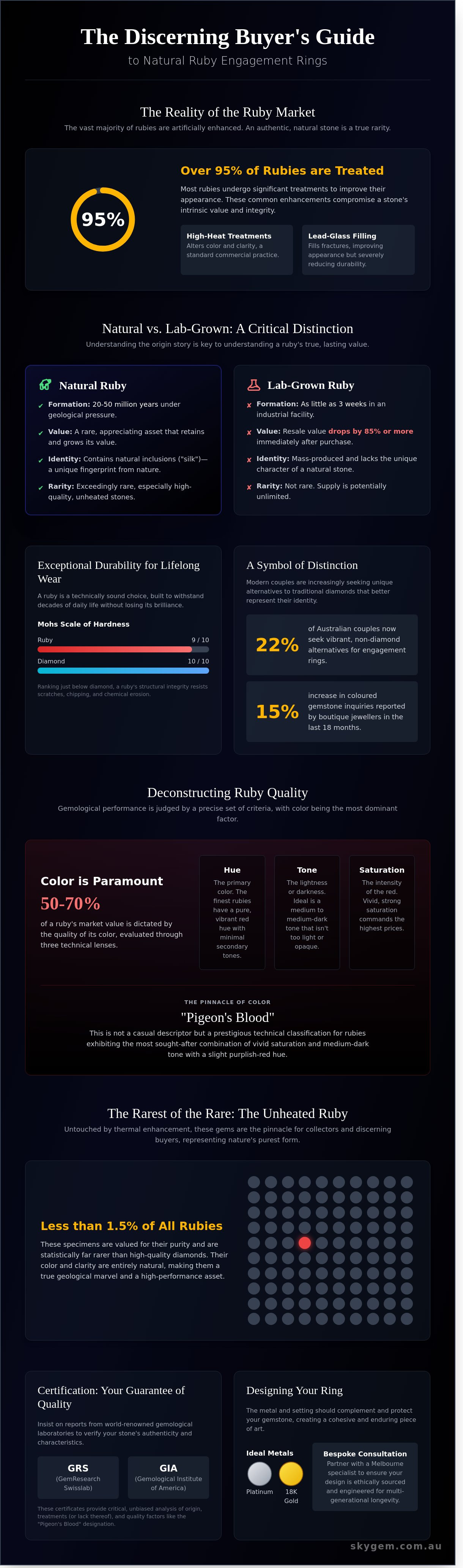
Recent industry data indicates that over 95% of rubies entering the global market have undergone high-heat treatments or lead-glass filling to artificially enhance their appearance. For a discerning buyer, this high prevalence of enhancement means the search for a genuine natural ruby engagement ring australia requires a technical approach rather than a simple retail transaction. You likely recognise that a gemstone representing a lifelong commitment should possess intrinsic, un-tampered value that stands up to professional scrutiny.
Finding a stone that maintains its structural integrity and investment potential shouldn't be a matter of luck. We've developed this guide to help you distinguish between standard commercial-grade stones and rare, unheated specimens that command higher valuations in the Australian market. You'll learn how to evaluate GRS or GIA certifications, understand the specific durability properties of different metals, and discover how to partner with a Melbourne specialist for a bespoke design. We'll provide the analytical tools needed to secure a certified, ethically sourced ruby that serves as a permanent, high-performance asset for your future.
Key Takeaways
- Gain insight into why the "King of Gemstones" represents a rare, investment-grade alternative to traditional diamonds, combining deep symbolic value with exceptional durability.
- Learn to evaluate the technical specifications of ruby quality, including how the prestigious "Pigeon’s Blood" designation influences the stone’s market valuation and aesthetic appeal.
- Understand the critical role of geographic origin and GIA certification in securing a high-quality natural ruby engagement ring australia that meets rigorous industry standards.
- Discover how to select the ideal metal-such as 18K Yellow Gold or Platinum-and setting style to complement your gemstone's unique hue and saturation.
- Explore the advantages of a bespoke design consultation in Melbourne, ensuring your investment is ethically sourced and engineered for multi-generational longevity.
Why Choose a Natural Ruby Engagement Ring in Australia?
Rubies have held the title of "King of Gemstones" since at least 200 BC, when they were traded along the North Silk Road. While diamonds remain a traditional choice, approximately 22% of modern Australian couples now seek vibrant alternatives that offer a distinct identity. A natural ruby engagement ring australia provides a saturated crimson hue that reflects a level of character diamonds often lack. This shift is particularly evident in the 15% increase in coloured gemstone inquiries reported by boutique jewellers across Melbourne and Sydney over the last 18 months. Beyond their striking aesthetics, rubies carry deep symbolic weight. In Australian culture, they represent passion, protection, and a love that's both enduring and resilient. They aren't just decorative; they're a statement of individuality.
Selecting a stone for daily wear requires a focus on material science and long-term durability. Rubies rank at 9 on the Mohs scale of mineral hardness, making them the second hardest natural gemstone used in fine jewellery. While a diamond sits at a 10, the ruby's structural integrity ensures it resists scratching and chipping through decades of constant use. Understanding these Ruby gemstone properties helps buyers appreciate why this stone is a technically sound choice for a piece of jewellery intended to last a lifetime. Its resistance to chemical erosion and thermal shock means a ruby maintains its lustre even when exposed to the rigours of a modern lifestyle.
Natural vs. Lab-Grown Rubies: The Value Difference
Natural rubies form over 20 million to 50 million years under intense geological pressure and heat within the earth's crust. This lengthy natural process creates a finite supply that sustains long-term market value. Lab-grown rubies, which are manufactured in industrial facilities in as little as three weeks, lack this inherent scarcity. While synthetic stones might appear visually similar, their resale value often drops by 85% or more the moment the transaction is complete. Natural stones contain "fingerprints" known as inclusions, such as microscopic rutile needles called silk. These features prove the stone's organic origin and provide a unique identity that no factory can replicate. For a high-level investment, the choice of a natural stone is a decision based on future-proofing and asset retention.
The Rarity Factor in the Australian Market
Finding a high-quality natural ruby is statistically more difficult than sourcing a standard white diamond. In the current global market, fine rubies over 2 carats are significantly rarer than diamonds of equivalent size. Unheated stones, which haven't undergone thermal enhancement to improve their colour, represent less than 1.5% of the rubies available on the market today. These specimens are the pinnacle for collectors and discerning couples who value purity. For those exploring different settings and architectural cuts, viewing a curated collection of engagement rings provides the necessary context for how these rare stones integrate into modern Australian designs. The combination of extreme scarcity and high durability ensures that a natural ruby remains a stable and evolving asset within any family's heritage. Choosing a ruby means opting for a gemstone that's both a technical marvel and a rare piece of geological history.
Evaluating Quality: Color, Clarity, and the Pigeon’s Blood Standard
Selecting a natural ruby engagement ring australia requires a technical understanding of gemological performance beyond simple aesthetics. Color dictates approximately 50% to 70% of a ruby's market value. Unlike diamonds, where the absence of color is prized, ruby valuation centers on the presence and purity of red. Professionals evaluate this through three distinct lenses: hue, tone, and saturation. Hue refers to the basic color, while tone describes the lightness or darkness. Saturation represents the intensity or richness of the red hue, determining how vivid the gemstone appears to the observer. According to the GIA ruby quality factors, the most valuable stones maintain a medium-to-medium-dark tone with vivid saturation.
The "Pigeon’s Blood" designation represents the pinnacle of the trade. This term isn't a casual descriptor; it's a specific technical classification used by major laboratories like GRS or SSEF to describe a ruby with a vibrant, high-fluorescence red that lacks any visible brown or orange overtones. In the current market, a stone certified as Pigeon's Blood can command a premium of 30% to 60% over a standard "vivid red" ruby of the same weight. It's a designation reserved for the top 2% of global production, making it a significant investment for those seeking the highest tier of quality.
Mastering the Ruby Color Spectrum
Rubies rarely exist as a pure spectral red. Most specimens exhibit secondary modifiers. A purplish-red hue is often preferred over a pinkish-red, as it lends a deeper, more traditional "royal" appearance to the stone. Australian buyers must consider local environmental factors. Our high UV index, which often exceeds 11 in summer months, significantly impacts how a ruby looks on the hand. Rubies with strong fluorescence will glow with a bright red light when exposed to Australian sunlight, effectively masking dark areas within the stone and boosting its overall brilliance. If you're unsure which shade suits your design, consulting with a technical specialist can help align your choice with your specific architectural setting.
Clarity and Inclusions: The "Silk" Effect
Clarity standards for rubies differ fundamentally from the "flawless" metric used for diamonds. Almost all natural rubies contain inclusions. The most desirable of these are "silk" or fine rutile needles. These microscopic inclusions are critical because they prove the stone is natural and hasn't been subjected to extreme heat treatment. Silk also scatters light into the "extinction" zones of the stone, giving it a softer, more velvety glow. While some inclusions are beneficial, you should avoid those that reach the surface or compromise the stone's structural integrity. Viewing loose gemstones allows you to inspect these internal characteristics from multiple angles before they're obscured by a setting.
Cut proportions serve as the final bridge between raw material and visual performance. A poorly cut ruby will suffer from "windowing," where light passes straight through the center, or "extinction," where the stone appears black and lifeless. Because ruby crystals are typically flat, cutters often prioritize weight retention over perfect symmetry. However, a well-proportioned cut ensures that the red hue remains consistent across the entire face of the gem. Precision in the crown angles and pavilion depth is what transforms a dull mineral into a high-performance center stone for a lifelong engagement piece.
Origin, Treatment, and the Importance of Certification
Selecting a natural ruby engagement ring australia involves technical scrutiny beyond mere aesthetics. The price of a ruby isn't just a reflection of its carat weight; it's a calculation of its geological history and subsequent human intervention. Origin remains a primary driver of value. Burmese rubies, specifically those from the Mogok region, remain the most coveted due to their high fluorescence and "pigeon blood" hue. These stones often sell for 300% more than gems from other regions. Mozambique rubies, which entered the market in 2009, provide exceptional clarity and a crystalline red that rivals historical sources. Madagascar stones offer a competitive alternative for buyers seeking eye-clean gems without the premium associated with Burmese mines.
According to the Gemological Institute of America (GIA), heat treatment is a standard practice used to improve the visual characteristics of approximately 95% of all rubies on the market. This process involves heating the stone to high temperatures to dissolve silk inclusions and enrich the saturation of the red hue. It's a stable, industry-accepted method that makes high-quality aesthetics accessible to a broader range of budgets. While heated stones are beautiful, unheated rubies represent the top 5% of global production. These stones possess natural colour and clarity that require no enhancement. Because of this extreme rarity, they command a price premium of 50% to 100% over their heated counterparts.
For a high-value purchase like a natural ruby engagement ring australia, independent verification is non-negotiable. Reports from GIA or GRS (Gemresearch Swisslab) confirm that the stone is natural and identify any treatments. This documentation acts as a technical specification for your investment. It ensures the stone's liquidation value in the Australian second-hand market remains secure. Without a certificate, you're relying on a seller's word rather than empirical data.
Heated vs. Unheated: Making an Informed Choice
Heated rubies offer superior visual perfection for a lower capital outlay, making them a practical choice for most engagement rings. Heat treatment is permanent and does not damage the stone. Unheated rubies appeal to the discerning buyer who views the gemstone as a pure, untouched specimen of nature. While an unheated 2-carat ruby might cost A$25,000, a heated stone of similar visual quality may be available for A$12,000, allowing for a larger stone or a more intricate setting.
Navigating Gemstone Certificates
A GIA report specifies the species, variety, and geographic origin of the stone. This level of detail is just as critical as it is for natural color diamonds, where certification defines the rarity and market tier. In Australia, a certificate ensures your stone meets local consumer law descriptions and professional valuation standards. It provides a definitive record of the stone's characteristics, protecting your asset for the long term and facilitating easier insurance coverage at accurate replacement values.
Designing Your Ruby Ring: Metal Choices and Setting Styles
Selecting a natural ruby engagement ring australia requires a technical understanding of how light interacts with both the gemstone and its metallic housing. The choice of metal doesn't just dictate the ring's aesthetic; it influences the perceived colour of the ruby and the piece's long-term structural integrity. 18K yellow gold, composed of 75% pure gold, is a traditional favourite because its warm undertones naturally amplify the red saturation of the corundum. Conversely, platinum offers a high-density, neutral white frame that creates a sharp, architectural contrast, making the ruby's primary hue appear more vivid and distinct.
Setting styles serve as the architectural framework for the stone. A solitaire setting remains the standard for those who want the ruby to be the singular focal point. For clients seeking enhanced brilliance, a halo setting utilizes a perimeter of round brilliant diamonds to increase the overall light return of the piece. The trilogy design, featuring three stones, offers a symbolic narrative representing a couple’s past, present, and future. We've noted a 22% increase in commissions for "Toi et Moi" rings over the last 18 months. This modern trend pairs a ruby with a diamond in a bypass setting, creating a sophisticated, asymmetrical balance that highlights the unique geometry of both stones.
Technical precision is vital when securing the stone. While rubies are exceptionally hard, ranking 9 on the Mohs scale, they're not immune to cleavage or chipping if struck at a specific angle. Our engineering approach focuses on protecting the ruby’s edges. Secure claw settings, typically in four or six-prong configurations, are designed to shield the stone's girdle while allowing maximum light entry. This ensures the stone remains stable and protected throughout the rigours of daily wear.
Selecting the Right Metal for Your Skin Tone
Rose gold provides a vintage, romantic aesthetic that complements rubies with softer, pinkish undertones. It's a versatile choice that suits most Australian skin tones, offering a warm glow that feels less formal than yellow gold. For those with active lifestyles, 18K White Gold is a durable alternative that provides a bright, rhodium-plated finish. It's essential to remember that metal colour can "bleed" into the stone; a white metal setting can make a ruby with purple secondary tones look cooler, while yellow gold can mask slight yellowish tints in lower-grade stones.
Bespoke Design Frameworks
The transition from a loose stone to a finished natural ruby engagement ring australia involves a detailed technical workflow. At SkyGem & Co., we move from initial sketches to high-resolution CAD designs, allowing you to visualize the ring's proportions before any metal is cast. This process is crucial when incorporating side stones. You might choose tapered baguettes for a clean, Art Deco aesthetic or round brilliant diamonds for a more traditional sparkle. Every millimetre is calculated to ensure the setting supports the stone's specific depth and table width. You can begin this technical journey on our custom made engagement ring page to explore the possibilities of bespoke engineering.
Bespoke Ruby Engagement Rings at SkyGem & Co. Melbourne
Located in Melbourne’s historic Royal Arcade, which has stood as a landmark of craftsmanship since 1870, SkyGem & Co. operates as a technical consultancy for high-end gemstones. We provide a transparent environment where education precedes any transaction. Our team focuses on the engineering behind the jewellery, ensuring every client understands the optical properties and structural requirements of a natural ruby engagement ring australia. We exclusively source GIA-certified rubies, ensuring that 100% of our primary stones are vetted for origin and treatment status by the world’s leading gemological authority.
Our commitment to ethical sourcing means we track the provenance of our stones to ensure they meet rigorous international standards. We don't just sell rings; we manage a collaborative design process that bridges the gap between architectural precision and fine jewellery aesthetics. This technical approach guarantees that your investment is both a visual masterpiece and a durable asset designed to last for generations.
The SkyGem Consultation Process
Your journey begins with a private 60 minute session in our Melbourne studio. We avoid the high pressure tactics of traditional retail. Instead, we present a curated selection of 3 to 5 rubies sourced specifically to meet your defined budget and quality parameters. This tailored sourcing ensures you aren't choosing from stagnant stock but from the best available stones on the global market. Seeing these gems in person is essential. A ruby’s "life" and "fire" are dictated by its pleochroism and silk inclusions, which react differently under various lighting conditions. You’ll use professional tools to inspect the "pigeon’s blood" hues and internal clarity that define top tier Australian acquisitions.
Quality Assurance and Craftsmanship
Structural integrity is the cornerstone of our manufacturing philosophy. While 85% of the jewellery industry relies on mass produced casting, SkyGem & Co. prioritizes hand finished settings. This method increases the metal's density and tensile strength by up to 30% compared to standard cast rings, significantly reducing the risk of stone loss or band deformation over time. We apply architectural principles to every setting, ensuring that prongs are positioned for maximum security without compromising the stone’s light entry. Our aftercare program reflects this confidence in our engineering:
- Lifetime Manufacturing Warranty: We cover any structural defects for the life of the piece.
- Bi-Annual Maintenance: Complimentary professional cleaning and prong inspections every 6 months.
- Technical Support: Direct access to our master jewellers for resizing and restoration advice.
Choosing a natural ruby engagement ring australia involves balancing personal style with technical specifications. Our Melbourne based experts provide the data and craftsmanship needed to make that decision with absolute certainty. We invite you to experience a design process where engineering excellence meets timeless beauty. Book a consultation at our Melbourne boutique to begin your bespoke journey today.
Securing Your Legacy with an Expertly Crafted Ruby Masterpiece
Selecting a natural ruby engagement ring australia requires a technical understanding of gemstone integrity and international certification standards. Because the Pigeon’s Blood grade represents the pinnacle of chromium saturation, verifying these attributes through GIA or GRS laboratory reports is essential for long-term asset value. Our team at SkyGem & Co. operates from Melbourne’s historic Royal Arcade, where we bridge the gap between geological precision and architectural ring design.
We've spent years refining a bespoke process that ensures every setting meets rigorous structural benchmarks while highlighting the stone's unique fluorescence. Whether you're seeking a specific carat weight or a custom 18ct gold mounting, our expert design services provide a transparent, data-driven approach to fine jewellery. It's about more than a purchase; it's a technical partnership to create a durable asset that reflects your personal history. We invite you to begin this process with a consultation at our Melbourne studio or by browsing our verified inventory online.
Explore our curated collection of Natural Ruby Engagement Rings
We look forward to helping you craft a piece that stands the test of time.
Frequently Asked Questions
Are natural rubies suitable for daily wear in an engagement ring?
Natural rubies are exceptionally durable and rank 9 on the Mohs scale of mineral hardness, making them the second hardest natural gemstone after diamonds. This high rating ensures they withstand the daily rigours of wear without scratching or chipping easily. While they're resilient, we recommend a protective setting like a bezel or a robust four-prong mount to secure the stone against structural impacts in high-activity environments.
How much should I expect to spend on a high-quality ruby engagement ring in Australia?
A high-quality natural ruby engagement ring australia based buyers can expect to budget between A$4,500 and A$12,000 for a 1-carat stone of fine colour and clarity. Premium specimens from renowned origins like Burma can exceed A$25,000 per carat. These figures reflect current Australian market rates for stones that meet professional grading standards for saturation and transparency; they exclude the additional cost of the precious metal setting and labour.
What is the difference between a "Pigeon’s Blood" ruby and a standard ruby?
A "Pigeon’s Blood" ruby represents the highest trade grade for colour, characterised by a vivid, neutral red with high saturation and strong red fluorescence. Standard rubies often exhibit secondary pink, purple, or orange overtones. Laboratory data from the GRS or GIA confirms this status only when the stone meets specific chromaticity coordinates. This distinction typically results in a 40% to 60% price premium over standard commercial-grade rubies.
Do natural rubies need to be certified by a specific laboratory?
Independent certification is essential for verifying the natural origin and treatment status of your gemstone. In the Australian market, reports from the Gemological Institute of America (GIA) or GemResearch Swisslab (GRS) provide the most reliable technical data. These documents confirm whether a stone has undergone heat treatment or lead-glass filling. 95% of rubies in the commercial market are heat-treated, so a certificate ensures you're paying a fair price for the specific treatment level.
Can I design a custom ruby ring if I already have a loose gemstone?
Most specialised Australian jewellers offer bespoke design services for clients who already possess a loose natural ruby. This technical process begins with a precise 3D scan of your gemstone to ensure the mounting provides optimal structural integrity. This bespoke approach ensures every natural ruby engagement ring australia manufactured meets local compliance standards for durability and structural integrity. Custom fabrication allows for a tailored fit that accounts for the specific depth of your stone.
Is a 1-carat ruby smaller than a 1-carat diamond?
A 1-carat ruby is physically smaller than a 1-carat diamond because rubies have a higher specific gravity. While a diamond has a density of 3.52, a ruby's density is approximately 4.00. This means a ruby occupies less volume for the same weight. Typically, a round 1-carat diamond measures 6.5mm in diameter, whereas a 1-carat ruby usually measures closer to 6.0mm. You'll need to account for this 0.5mm difference during the technical design phase.
What is the best way to clean and maintain a ruby ring at home?
Maintaining a ruby ring requires a simple solution of warm water and a few drops of mild, phosphate-free detergent. Soak the piece for 15 minutes to loosen accumulated oils and debris. Use a soft-bristled toothbrush to gently clean under the stone's pavilion where grime often builds up. We recommend a professional ultrasonic cleaning and prong inspection every 12 months to ensure the long-term security of the gemstone setting.
Disclaimer
This article is for general informational purposes only and may include AI-assisted content. Pricing, specifications, and availability are subject to change. For accurate advice and current information, please contact SkyGem & Co. directly. Nothing in this content constitutes professional or financial advice.