
Alexandrite Gemstones: The Ultimate 2026 Buying Guide to the World’s Rarest Colour-Shift Gem

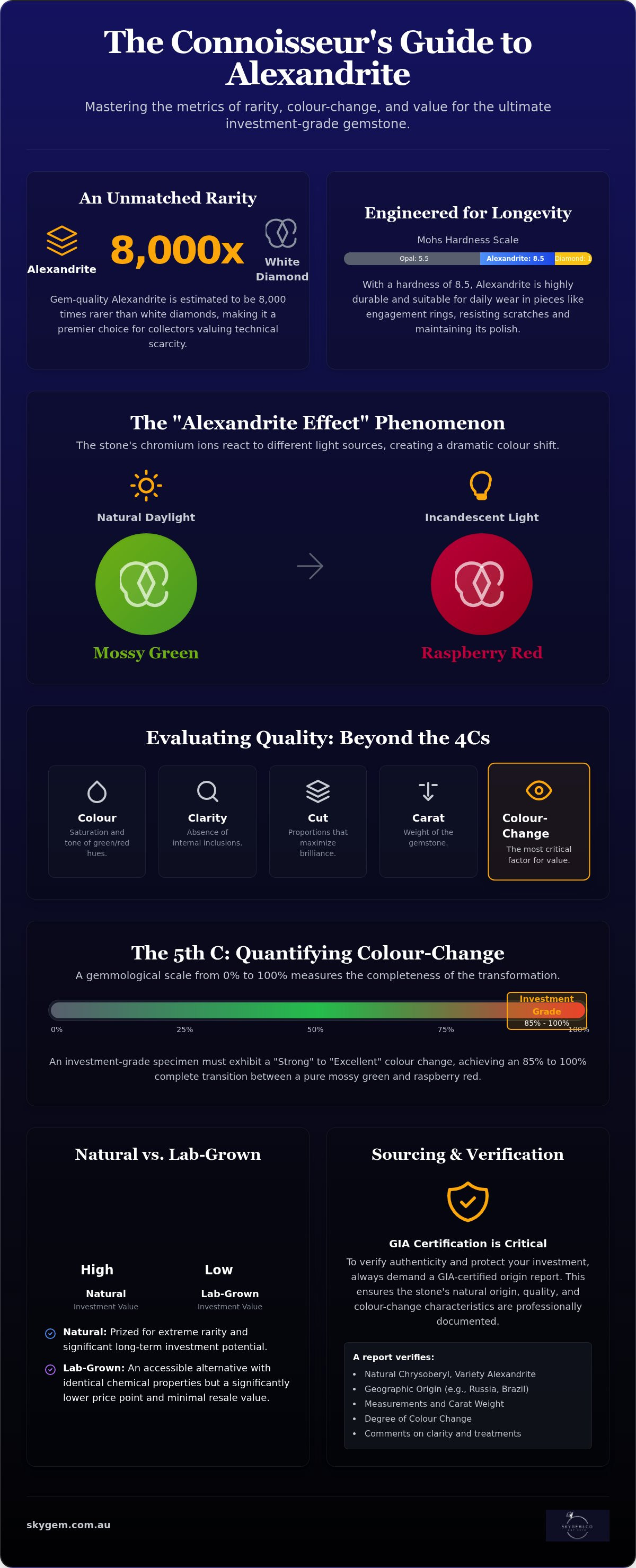
Did you know that gem-quality alexandrite is estimated to be roughly 8,000 times rarer than white diamonds? While many collectors focus on traditional stones, the true connoisseur understands that alexandrite gemstones offer a level of exclusivity and optical complexity that few other minerals can match. This extreme rarity makes the acquisition process both rewarding and technically demanding.
We recognize that selecting a stone is often a challenge, particularly when you're trying to distinguish between a genuine natural specimen and a sophisticated lab-grown alternative. The nuances of quantifying a "top-grade" colour shift can be confusing, and the fear of overpaying in a volatile market is a valid concern for any serious buyer. Our approach focuses on technical precision to ensure your selection remains a permanent and evolving asset.
This guide provides the framework you need to master the metrics of colour-change percentage and clarity that define investment-grade quality in 2026. We will analyze the current price-per-carat landscape and show you how to identify a reputable Australian source for bespoke settings that respect the integrity of such a rare find.
Key Takeaways
- Define the "Alexandrite Effect" and the technical reasons behind the transition from mossy green to raspberry red across different light sources.
- Master the evaluation of the "5th C"—colour-change percentage—to accurately quantify the quality and market value of alexandrite gemstones.
- Navigate the significant price disparity between natural and lab-grown stones to ensure your acquisition aligns with your long-term investment objectives.
- Optimise bespoke jewellery designs by selecting metal tones that enhance dual-phase performance while leveraging the stone's 8.5 Mohs hardness for durability.
- Identify the critical necessity of GIA-certified origin reports and transparent sourcing protocols to verify the authenticity of high-grade specimens.
What is Alexandrite? The "Emerald by Day, Ruby by Night" Phenomenon
Alexandrite is a rare variety of the mineral chrysoberyl that exhibits a remarkable optical transformation. While standard chrysoberyl is often yellow or green, the presence of specific trace elements creates what gemologists call the "Alexandrite Effect." This phenomenon allows the stone to appear vivid green in natural daylight and shift to a deep, purplish red under incandescent light. Discovered in the 1830s within Russia's Ural Mountains, the stone was named in honour of Tsar Alexander II. Its historical prestige is matched only by its extreme scarcity. High-quality natural alexandrite gemstones are significantly harder to find than white diamonds or sapphires. In fact, locating a natural specimen over one carat with a distinct colour shift is a rare event in the global market. This makes it a premier choice for collectors who value technical rarity over mass-market appeal.
The Science of the Colour Shift
The dramatic transformation within an Alexandrite gemstone is driven by the presence of chromium ions within the crystal lattice. These ions absorb light in the yellow and blue regions of the spectrum while allowing green and red wavelengths to pass through. It's essential to distinguish this from pleochroism. While pleochroism involves a stone showing different colours when viewed from different angles, a true colour-change gem like alexandrite reacts to the spectral composition of the ambient light itself. The most coveted specimens exhibit a "pure" transition, moving from a mossy emerald green to a rich, raspberry ruby red without the presence of distracting grey or brown modifiers. Achieving this 100% colour shift requires a precise balance of chemical impurities that occurs only in the most specific geological conditions.
Why Alexandrite is the Ultimate Alternative Engagement Stone
For those seeking a departure from traditional white diamonds, alexandrite provides a sophisticated alternative that balances aesthetic beauty with long-term viability. Its hardness rating of 8.5 on the Mohs scale ensures it can withstand the rigours of daily wear, a critical factor for any bridal piece. Unlike softer gemstones that may abrade over time, alexandrite maintains its polish and structural integrity. Beyond its physical properties, the stone carries a rich symbolic legacy of luck, fortune, and balance. Selecting alexandrite gemstones for a bespoke engagement ring allows for a highly personalised design that reflects the wearer's multifaceted personality. By choosing a centre stone that literally changes with the environment, you invest in a piece of jewellery that remains dynamic and engaging throughout its lifetime. This adaptability makes it a perfect centrepiece for those who appreciate both technical engineering and high-level aesthetic design.
Evaluating the 5Cs of Alexandrite: Colour Change and Quality
Standard gemstone evaluation typically relies on the traditional 4Cs: colour, clarity, cut, and carat weight. However, alexandrite gemstones require a more complex framework that includes a critical 5th C: Colour Change Percentage. While a diamond's value is often determined by its absence of colour, an alexandrite's worth is dictated by the completeness and quality of its optical transformation. Professionals refer to GIA on Alexandrite quality standards to assess how saturation and tone influence this shift. High saturation is desirable, but if the tone is too dark, the stone can appear "extinct" or black, effectively masking the colour change. Conversely, a tone that is too light often results in a weak, greyish shift that lacks the "emerald by day, ruby by night" impact.
Quantifying the Colour Change (The 5th C)
Gemmologists use a 0% to 100% scale to quantify the degree of transformation. For a specimen to be considered investment grade in 2026, it must exhibit a "Strong" to "Excellent" colour change covering at least 85% to 100% of the stone's surface. A 100% shift represents a total transition between two distinct hues. You can test this at home by moving the stone between natural daylight and a standard incandescent bulb. If you notice a lingering "muddy" brown or grey middle phase, the shift is incomplete. This completeness is the primary driver of market value; a smaller stone with a 100% shift often commands a higher premium than a larger stone with a partial 40% change.
Carat Weight and Rarity Scaling
The rarity of natural alexandrite increases exponentially with its size. While you might find small melee stones with relative ease, specimens exceeding the 1.00 carat mark are exceptionally rare. Market data shows significant price-per-carat jumps at the 0.50ct, 1.00ct, and 2.00ct thresholds. When planning a custom jewellery design, it's often more practical to prioritise colour change percentage over raw carat weight to ensure the finished piece maintains its visual impact. Selecting a high-quality 0.80ct stone with a vivid shift frequently provides better long-term value than a lacklustre 1.20ct stone. If you're looking for a specific weight to anchor a new project, exploring our curated collection of alexandrite can help you find a stone that balances technical grade with aesthetic presence.
Natural vs. Lab-Grown Alexandrite: An Investment Perspective
When evaluating the market for alexandrite gemstones, it's vital to distinguish between geological origin and chemical composition. Lab-grown alexandrite is genuine chrysoberyl, possessing the same refractive index, crystal structure, and 8.5 Mohs hardness as its natural counterpart. However, the market assigns a vast price disparity between the two. Natural stones often command 10 to 20 times the price of man-made alternatives. This premium isn't merely for aesthetic reasons; it reflects the extreme rarity of a mineral that requires both beryllium and chromium to meet in the Earth's crust, a geological event that occurs with vanishing frequency. For those viewing their purchase as a vehicle for wealth preservation, natural alexandrite remains a premier "legacy" gemstone that typically holds or appreciates in value over time.
Prospective buyers must also be cautious of the "simulated" alexandrite trap. Unlike lab-grown stones, which are chemically identical to natural ones, simulated stones are often just colour-change sapphires or treated glass. These materials don't possess the technical properties of true chrysoberyl and have negligible resale value. While they might mimic the colour shift, they lack the brilliance and durability of the real mineral. Understanding these distinctions is the first step in ensuring your capital is allocated to a stone with genuine long-term viability.
The Benefits of Lab-Grown Alexandrite
For modern settings where budget efficiency is a priority, lab-grown stones offer a compelling solution. These gems are created using controlled thermal processes that result in "eye-clean" specimens with highly predictable colour shifts. They provide an ethical and environmental advantage by bypassing the intensive mining processes required for natural extraction. Choosing from available lab-grown gemstone options allows you to secure a larger, high-clarity centre stone that would be prohibitively expensive in the natural market. It's a practical choice for those who value the technical "Alexandrite Effect" but don't require the stone to serve as a financial investment.
Identifying Natural Stones: GIA Certification
You should never acquire a natural alexandrite without a comprehensive report from an independent laboratory. A professional report from the GIA or GAA acts as a technical audit, verifying the stone's origin, the presence of any treatments, and its authenticity as natural chrysoberyl. These documents use advanced spectroscopy to ensure the stone isn't a lab-grown specimen or a simulated lookalike. Referencing GIA's guide to alexandrite quality factors can help you interpret these findings with confidence. GIA certification is the gold standard for gemstone security because it provides an immutable record of a stone's geological identity and treatment history. This level of transparency is essential for protecting the integrity of your collection and ensuring the long-term success of your project.
Design and Durability: Setting Your Alexandrite for Longevity
Selecting the right setting for alexandrite gemstones requires a balance between technical protection and optical performance. With a hardness rating of 8.5 on the Mohs scale, alexandrite is exceptionally durable, sitting just below sapphire and diamond. This physical property makes it an ideal candidate for daily wear in engagement rings, as it resists the surface scratching and facet wear that often plagues softer minerals. While the stone's structural integrity is high, the design of the setting must prioritise light entry to facilitate the "Alexandrite Effect" discussed earlier. A solitaire setting is often the most effective method for allowing light to penetrate the crystal lattice from multiple angles, ensuring the colour shift remains vivid. For stones under one carat, a halo setting can effectively increase the visual footprint while providing an additional layer of protection for the centre stone's girdle.
The Impact of Metal Colour on Colour Shift
The choice of metal significantly influences how the human eye perceives the stone’s transition. Using 18K White Gold or platinum is the preferred technical choice for those who want to emphasise the cool, mossy green daylight phase. The neutral, reflective surface of white metal provides a crisp backdrop that doesn't compete with the stone’s secondary hues. Conversely, Rose Gold can be used strategically to enhance the warmth of the incandescent red or purplish-red phase. For a balanced aesthetic that respects both ends of the spectral shift, mixed-metal settings offer a sophisticated solution. By using white gold prongs on a rose gold band, you can maintain the purity of the green phase while warming the overall appearance of the ring.
Protecting Your Investment
While the mineral itself is tough, the method of setting determines the long-term security of the specimen. A bezel setting provides a protective metal rim around the entire circumference, which is ideal for clients with active lifestyles who may subject their jewellery to occasional impacts. However, if your priority is maximum brilliance, a traditional four or six-prong setting remains the industry standard. We recommend professional jewellery maintenance every 12 months to ensure the structural integrity of these prongs. Regular checks prevent stone loss and allow for the removal of built-up oils that can dull the stone's refractive performance. At home, a simple solution of warm water and mild detergent is sufficient for routine cleaning, keeping the facets clear for optimal light return.
If you're ready to begin the engineering process for a piece that showcases these unique optical properties, you can explore our range of bespoke engagement rings to find the perfect foundation for your stone.
Sourcing Premium Alexandrite Gemstones at SkyGem & Co.
Selecting a high-grade colour-shift gem requires more than just an aesthetic eye; it demands access to a transparent supply chain and technical expertise. At SkyGem & Co., we act as your technical consultant throughout the acquisition process. Our inventory features a curated selection of loose alexandrite gemstones that have been vetted for their optical performance and structural integrity. We understand that a stone of this rarity is a permanent asset, which is why we prioritise GIA-certified sourcing for every natural specimen in our collection. This commitment to documentation ensures that the metrics of colour-change percentage and origin are verified by the world's leading gemmological authority, providing you with absolute certainty before the design phase begins.
Our role extends beyond simple retail. We partner with clients to navigate the complexities of gemstone selection, focusing on the intersection of technical precision and artistic vision. Whether you are looking for a stone to anchor a new project or seeking to upgrade a legacy piece, our team provides the data-driven insights necessary to make an informed decision. By integrating our deep understanding of mineral properties with your personal design goals, we create precious gemstone jewellery that stands as a benchmark of quality and regional craftsmanship.
Standout Stones in Our Collection
The SkyGem & Co. inventory is specifically tailored to showcase the most desirable traits of the chrysoberyl family. We maintain a range of both natural and rare unheated alexandrite varieties, each selected for its unique spectral response. Our collection emphasises precision-cut ovals and cushions. These specific shapes are engineered to maximise light return, which is essential for showcasing a high colour-change percentage from every viewing angle. Unlike native-cut stones that may have "windows" or light leakage, our precision-cut specimens ensure that the transition from green to red is edge-to-edge. You can view the specific carat weights and dimensions currently available by exploring our Alexandrite Gemstone Collection online.
Start Your Bespoke Journey
The transition from a loose stone to a finished masterpiece is a methodical process rooted in collaborative design. Once you select your centre stone, we move into the CAD (Computer-Aided Design) phase. This allows us to calibrate the metal tolerances and setting heights to protect your investment while ensuring optimal light entry. Our consultants are available to help you navigate technical specifications, from metal density to prong placement, ensuring the final piece is both durable and visually striking. This structured approach respects your time and ensures the long-term success of the project. We invite you to browse the full range of alexandrite gemstones and start your custom design today to secure a piece of the world's rarest colour-shift mineral.
Secure Your Legacy with Rare Optical Precision
Acquiring a world-class specimen requires a refined balance of technical knowledge and aesthetic appreciation. We have explored how the completeness of the colour shift dictates market value and why GIA certification remains the non-negotiable standard for verifying natural authenticity. Whether you prioritise a natural legacy stone for wealth preservation or a high-performance lab-grown alternative for its visual clarity, the 8.5 Mohs hardness of this mineral ensures it remains a permanent asset in your collection. As you move forward with your acquisition, remember that alexandrite gemstones represent a unique intersection of geological rarity and technical engineering.
SkyGem & Co. acts as your dedicated consultant in this process, providing GIA certified natural stones and expert bespoke design services tailored to your specific requirements. As specialists in rare colour-change gems, we are committed to ensuring your selection meets the highest standards of performance and structural integrity. View our curated collection of rare Alexandrite Gemstones and begin the process of creating a piece that reflects your own multifaceted story. We look forward to partnering with you on this journey of discovery and precision design.
Frequently Asked Questions
Is alexandrite rarer than a diamond?
Yes, gem-quality alexandrite is significantly rarer than white diamonds. Industry data suggests that high-grade specimens are roughly 8,000 times scarcer than their diamond counterparts. This extreme rarity is a result of the unique geological conditions required for beryllium and chromium to merge in the Earth's crust, an event that occurs far less frequently than the formation of carbon-based diamonds.
How much does a 1-carat natural alexandrite cost in 2026?
The market value of a natural stone in 2026 is primarily driven by its origin and the percentage of its colour transformation. You'll observe that valuations scale exponentially with carat weight, particularly for stones that exhibit a 100% shift from green to red. Specimens from historical locations like Russia command the highest market premiums due to their intense colour saturation and historical significance. Larger stones are so rare that they are often treated as individual capital assets.
Can I wear an alexandrite engagement ring every day?
You can confidently wear alexandrite every day due to its high durability. It possesses a Mohs hardness rating of 8.5, which positions it just below sapphire and diamond. This technical profile ensures the stone resists surface scratching and facet abrasion during routine activities. It's an ideal choice for engagement rings that require long-term structural integrity and a permanent, high-level polish that remains vibrant over time.
Does alexandrite change colour in all types of light?
Alexandrite requires specific light wavelengths to trigger its optical shift. It typically transitions from mossy green in natural sunlight to a purplish-red under incandescent light sources. You might find that the shift is less dramatic under standard office fluorescent or certain LED lights, as these sources often lack the full spectrum of wavelengths necessary to activate the chromium ions within the crystal lattice of the stone.
What is the difference between lab-grown and simulated alexandrite?
Lab-grown alexandrite is chemically identical to natural chrysoberyl, whereas simulated alexandrite is a different material entirely. Simulations are usually colour-change sapphires or treated glass designed to mimic the appearance of alexandrite gemstones. While lab-grown stones share the same 8.5 hardness and refractive index as natural gems, simulated versions lack these technical properties and have near-zero resale value in the professional market.
What is the best cut for an alexandrite gemstone?
Oval and cushion cuts are the most effective for maximising the stone's colour-change performance. These shapes allow for the depth required to concentrate light within the crystal, which intensifies the perceived shift between green and red phases. Precision cutting is essential for alexandrite gemstones to ensure that the transition is uniform across the entire face of the stone rather than appearing in isolated patches or windows.
Why does my alexandrite look brownish in certain lights?
A brownish appearance often indicates that the stone has secondary hues or a lower saturation level. This "muddy" effect is common in specimens where the tone is either too dark or the chromium balance is imperfect. It frequently occurs in mixed lighting environments where the stone is struggling to transition fully between its daylight and incandescent phases. Higher-grade stones maintain pure colours without these distracting modifiers.
Is alexandrite a good investment for the future?
Natural alexandrite is considered a premier legacy asset for wealth preservation because of its extreme rarity and historical value appreciation. Market data indicates that top-tier one-carat stones have seen a value increase of approximately 300% over the last decade. With the global gemstone market projected to grow at a compound annual rate of 6.6% through 2036, high-quality specimens with strong colour shifts remain a viable and evolving asset for serious collectors.
Disclaimer
This article is for general informational purposes only and may include AI-assisted content. Pricing, specifications, and availability are subject to change. For accurate advice and current information, please contact SkyGem & Co. directly. Nothing in this content constitutes professional or financial advice.